
Manufacturing
From culm to carton in six stages
Each stage below names the machine that performs it and the tolerance it has to hold. Together they buy you three things: consistent diameter across a container, a polished stick that does not splinter in service, and zero chemical residue on anything that touches food.

How are bamboo skewers manufactured?
Bamboo skewers are made in six stages: mature culms are harvested at three to five years, cross-cut and split radially, sized on a filament size-setting machine to ±0.1 mm, polished in a rotary drum to remove hairs, pointed on a head-sharpening machine, then kiln dried below 12% moisture, inspected and carton packed.
- Diameter tolerance ±0.1 mm, verified per batch.
- Mechanical polishing only — no bleach, wax or coating.
- Kiln dried below 12% moisture before packing.
- Six-point QC before counting and carton sealing.
The six stages
 01
01Harvest & selection
Manual grove harvest
Culms are cut at 3–5 years, the age at which fibre density peaks. Younger culms are left to mature; the rhizome is never removed, so the grove regrows without replanting.
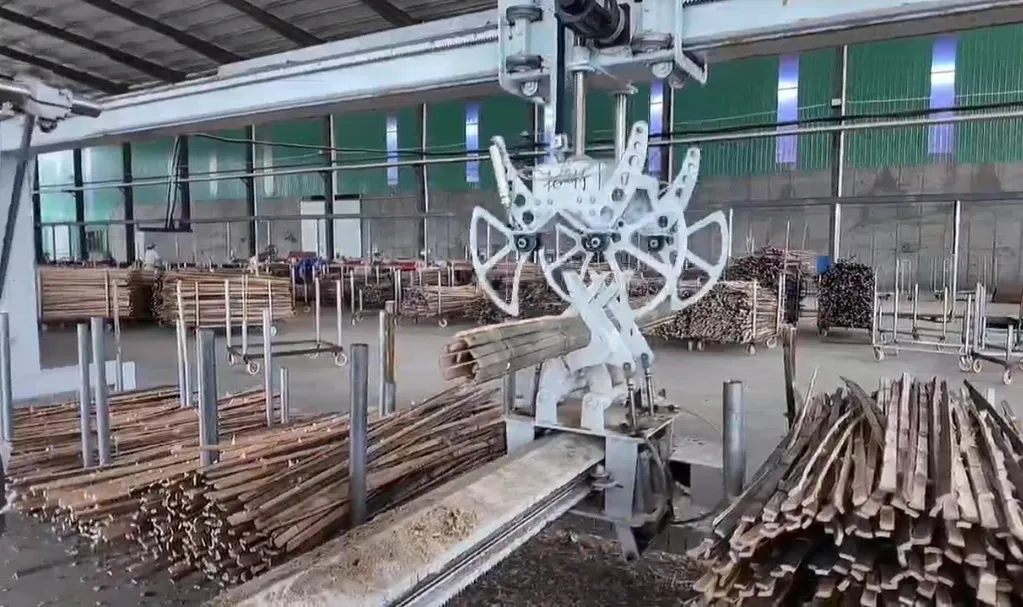
Harvest intake — mature culms are graded and staged on the infeed before cutting.
 02
02Cross-cut & splitting
Cross-cut saw and radial splitter
Culms are cut to working length and split radially into strips. Node sections are separated and diverted to briquette feedstock.
Cross-cut & splitting — culms are cut to working length and split radially into strips.
 03
03Filament size setting
Filament size-set machine
Strips pass through the size-setting head to a uniform diameter with a tolerance of ±0.1 mm across the batch.
Filament size setting — strips run through the sizing heads to a uniform diameter, ±0.1 mm.
 04
04Cutting in different sizes
Length-cutting and sizing line
Sized filaments are clamped in bundles and cut to finished lengths — 4 inch picks through 24 inch skewers — with length held square and consistent across the bundle.
Length cutting — clamped bundles are cut to finished lengths from 4 inch picks to 24 inch skewers.
 05
05Polishing and head sharpening
Rotary drum polisher and head sharpening machine
Sticks tumble against abrasive media to remove hairs and raise a smooth surface — no wax, bleach or coating. Only skewers, chopsticks and toothpicks then go to the sharpening machine for a consistent point; paddles, flags, stirrers and lollipop sticks skip this and go straight on.
Polishing, then sharpening for skewers, chopsticks and toothpicks only — no wax, bleach or coating.
 06
06Drying, QC & packing
Kiln and inspection line
Kiln drying takes moisture below 12%. Batches are checked for diameter, length, straightness, splinters and moisture before counting and carton packing.
Counting and packing — bulk packs are weighed, counted and sealed for carton loading.


Quality control protocol
| Check | Method | Tolerance |
|---|---|---|
| Diameter | Digital calliper, 20-piece sample per batch | ±0.1 mm |
| Length | Gauge block against jig | ±1.0 mm |
| Moisture | Pin moisture meter after kiln | Below 12% |
| Straightness | Roll test on flat bed | No visible bow over length |
| Surface | Visual and hand-pass for hairs and splinters | Zero splinters accepted |
| Count | Counting machine plus manual re-check | ±0.5% of pack count |
Capacity, lead time and OEM
Lead times
Stocked sizes 5–7 working days. Custom sizes and printed packaging 21–30 days from artwork approval. Container loads scheduled against vessel dates.
Private label and OEM
Inner packs, sleeves, kraft boxes and paddle heads are printed to your artwork. Barcodes allocated on request. Development enquiries welcome for new formats.
Capacity figures
Monthly output and machine counts will be published once confirmed. We would rather leave this blank than quote a number we cannot stand behind.
Manufacturing questions
What tolerance can you hold on diameter?
±0.1 mm across a batch, set at the filament size-setting stage and verified with a 20-piece calliper sample per batch.
How is the smooth finish achieved?
Mechanically. Sticks tumble in a rotary drum polisher against abrasive media. There is no bleaching, waxing or coating step.
What is the production lead time?
Stocked sizes ship in 5–7 working days. Custom sizes, printed packaging and container loads take 21–30 days from artwork approval.
Can you produce a non-standard size?
Yes. Tooling for custom lengths and head shapes is set up per order; share the drawing or a sample and we will confirm feasibility and MOQ.